
Padel Court Dimensions & Net Height (Official Rules)
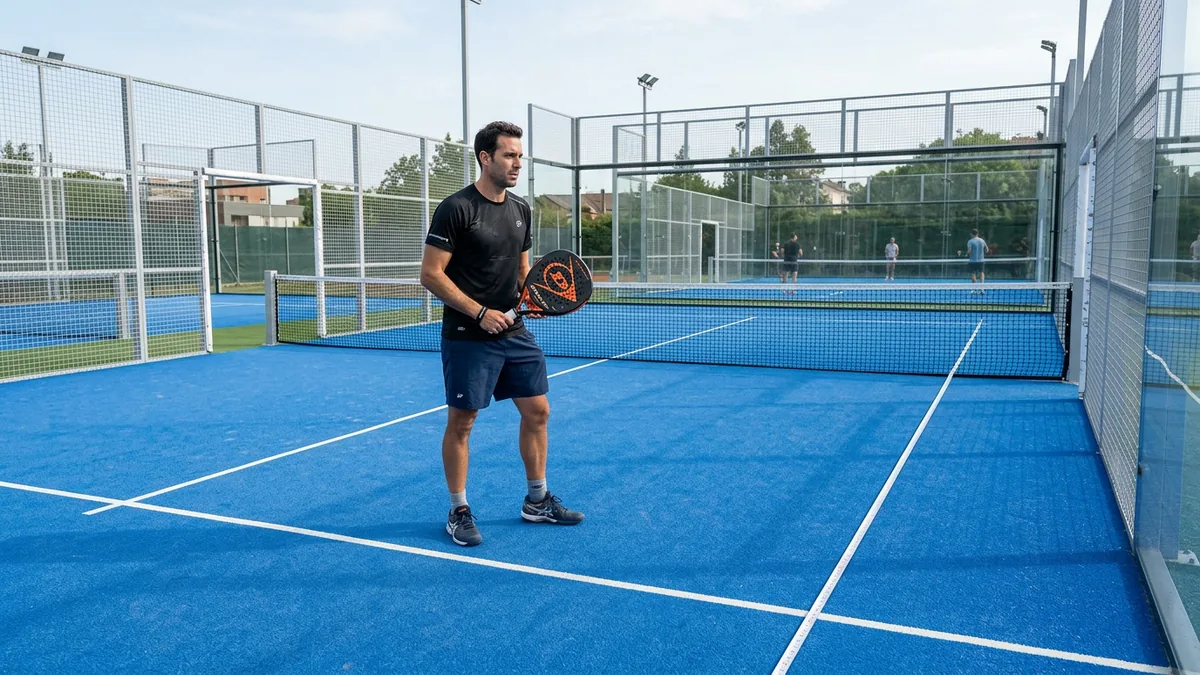
Before you step onto a padel court, it helps to know exactly what you’re stepping onto. The court is smaller than a tennis court, enclosed by glass and mesh, and full of lines and angles that decide how every single point is played.
Whether you’re building a court, choosing between clubs, or just trying to understand why the ball behaves the way it does, these are the official numbers — the same measurements used in every international competition.
The Playing Area: 10m x 20m
With the court layout in mind, mastering the serve is your first real weapon. Read more about the court setup here
A padel court is a rectangle exactly 10 metres wide and 20 metres long. That’s the same court used in official competition worldwide, and it’s less than half the length of a tennis court — one big reason rallies are so much longer in padel: there’s simply less ground to cover.
| Dimension | Official measurement |
|---|---|
| Court length | 20m |
| Court width | 10m |
| Total playing area | 200 m² |
| Service line distance from net | 3m |
| Service box size | 5m wide x 3m deep |
The net divides the court in half, and each half is marked with the same set of lines: a service line running parallel to the net at 3m, and a middle line running from the net to the service line. Together they create four service boxes, each 5m wide and 3m deep — two on each side of the net.
The playing surface itself is almost always artificial grass laid over a solid base, sometimes dressed with a thin layer of sand. That surface slows the ball just enough to make control and placement the most valuable skills on court. Courts are typically built slightly recessed, with the walls rising directly from the surface so rebounds stay true and water drains cleanly off the playing area.
Walls: The Court’s Signature Feature
Padel is the only one of the major racket sports where the court itself is part of the game. The walls are regulation, not decoration.
| Wall | Height |
|---|---|
| Side walls | 3m |
| Back wall | 4m, spanning the full 10m width |
| Mesh above the walls | Optional, typically 2–4m extra |
The side walls run along the court’s length at 3m high, while the back wall — which spans the full 10m width behind each baseline — stands 4m high under official rules. Most courts use tempered glass for the lower sections and metal mesh above, which lets spectators watch the action. In many clubs, a fence extends a few metres above the walls to keep stray balls inside the facility.
Net Height: 0.88m at Center, 0.92m at Posts
The net is lower at the center than at the posts — and both measurements are specified by the rules:
| Net position | Height |
|---|---|
| Center | 0.88m |
| Posts | 0.92m |
| Net length | 10m |
The net posts sit just outside the sidelines, one on each side of the court. The rules specify both the center and post heights because a perfectly flat net is physically impossible — the 4cm drop toward the center is built into the design. That low, slightly sagging net is exactly why underhand shots, drop volleys, and flat low drives are so effective in padel: the ball simply doesn’t have much net to clear.
Service Boxes and Key Lines
Every line on a padel court is exactly 5cm wide, and all of them are part of the play — a ball that touches a line is in. Here’s the full layout:
| Line | Location |
|---|---|
| Service line | 3m from the net, parallel to it, on each side |
| Middle line | Divides the service boxes, from the net to the service line |
| Baseline (back line) | The 20m mark, where the serve is taken from |
| Sidelines | The 10m marks, running along the side walls |
The serve must be taken from behind the baseline, and the ball must land in the diagonally opposite service box — the same principle as tennis, just with a shorter court and the underhand delivery.
Why the Dimensions Matter for Your Game
The geometry of the court shapes every strategy in padel. The 3m and 4m walls create the rebounds you play off and the angles you defend; the low 0.88m net invites underhand shots and soft drop volleys; the 3m service line keeps serves short and fair; and the 10m x 20m rectangle keeps four players constantly involved. Every number on this page affects how a point actually unfolds — so the next time you stand behind the baseline, you’ll know exactly why the court is built the way it is.
For a quick reference, here are the essential numbers in one place:
| Measurement | Value |
|---|---|
| Court | 10m x 20m |
| Side walls | 3m high |
| Back wall | 4m high, 10m wide |
| Net | 0.88m center, 0.92m posts |
| Service line | 3m from the net |
| Service box | 5m x 3m |
And because the court rewards control and placement over raw power, what you hold in your hand matters more than how hard you swing. Understanding the space is step one; equipping yourself to use it — a racket whose weight and balance suit your game — is step two.
Frequently Asked Questions
What are the official padel court dimensions?
An official padel court is 10 meters wide and 20 meters long, with side walls 3m high and back walls 4m high. The net is 0.88m in the center and 0.92m at the posts.
How high are padel court walls?
Side walls are 3 meters high; the back wall is 4 meters high across the 10m back of the court.
Not sure which racket is right for you?
Our AI analyzes your playing style and recommends the perfect racket — in under 2 minutes.
Try the Racket Finder →